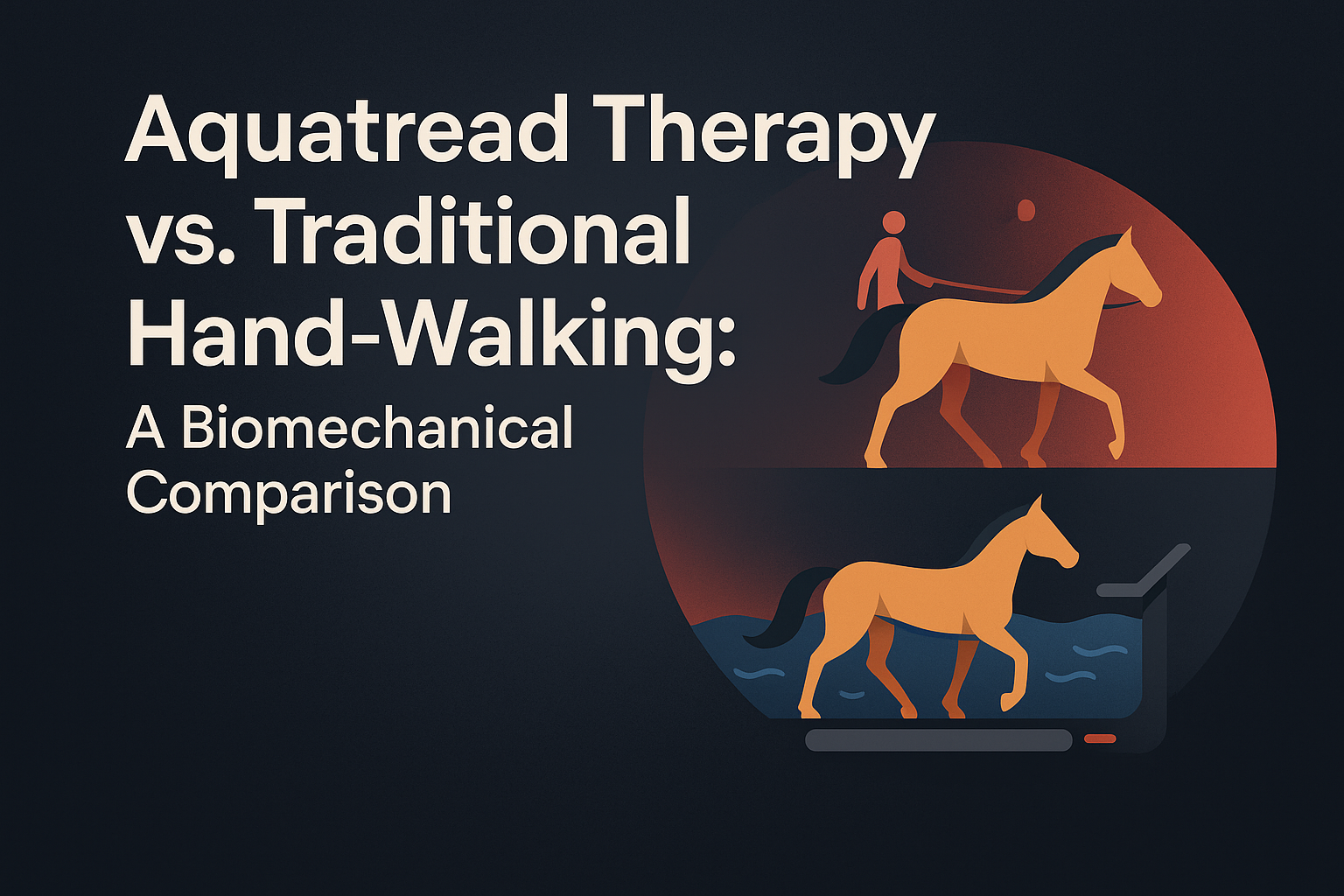
Hand-Walking Fundamentals
Hand-walking keeps horses moving during recovery. Handlers lead them in straight lines or small circles, promoting circulation and light conditioning.
This method shines for controlled steps post-injury. Yet biomechanically, it places full body weight on limbs, stressing joints like the fetlock and hock under gravity's pull. Repetitive turns add rotational torque, potentially unevenly loading the suspensory ligaments. For high-performance horses, this can mean slower gait normalization if overdone.
Aquatread Therapy Mechanics
Aquatread uses an underwater treadmill. Horses walk on a belt submerged in chest-deep water, reducing weight-bearing by up to 60% depending on depth.
Water buoyancy unloads joints while resistance builds muscle symmetrically. The enclosed environment ensures straight-line motion, minimizing lateral stress. Sensors track stride length, speed, and symmetry in real-time, allowing precise adjustments. Evidence from equine studies shows improved proprioception without the compressive forces of dryland walking.
Key Biomechanical Differences
- Joint Loading: Hand-walking transmits 100% body weight vertically. Aquatread cuts this by 40-70%, easing peak forces on cartilage and bone.
- Stride Dynamics: Traditional methods often shorten strides due to caution or terrain. Underwater treading extends protraction and hindlimb reach, mimicking natural movement patterns.
- Muscle Activation: Water drag engages stabilizers evenly. Hand-walking favors primary flexors, risking imbalances in elite athletes.
- Impact Absorption: Hard ground jars the spine in hand-walks. Buoyancy softens every step, protecting the vertebral column.
Force plate data reveals Aquatread reduces vertical ground reaction forces by half compared to overground walking at similar speeds.
Recovery Outcomes and Considerations
For tendon injuries, Aquatread accelerates healing by promoting even collagen alignment—hand-walking risks micro-tears from inconsistent loading. Vets note faster return-to-work timelines with aquatic protocols.
Hand-walking risks handler fatigue or horse resistance, leading to inconsistent sessions. Both methods demand monitoring for signs of discomfort, but Aquatread's adjustability edges it for precision rehab.
Performance trainers favor Aquatread for maintaining topline muscle without bulk-up delays. It's not a replacement—combine them strategically for optimal results.
Choosing the Right Tool
Biomechanics favor Aquatread for intensive rehab phases. Hand-walking suits early mobilization or maintenance.
Your horse's injury profile dictates the mix. Consult imaging and gait analysis to decide. Either way, consistent application beats sporadic efforts every time.