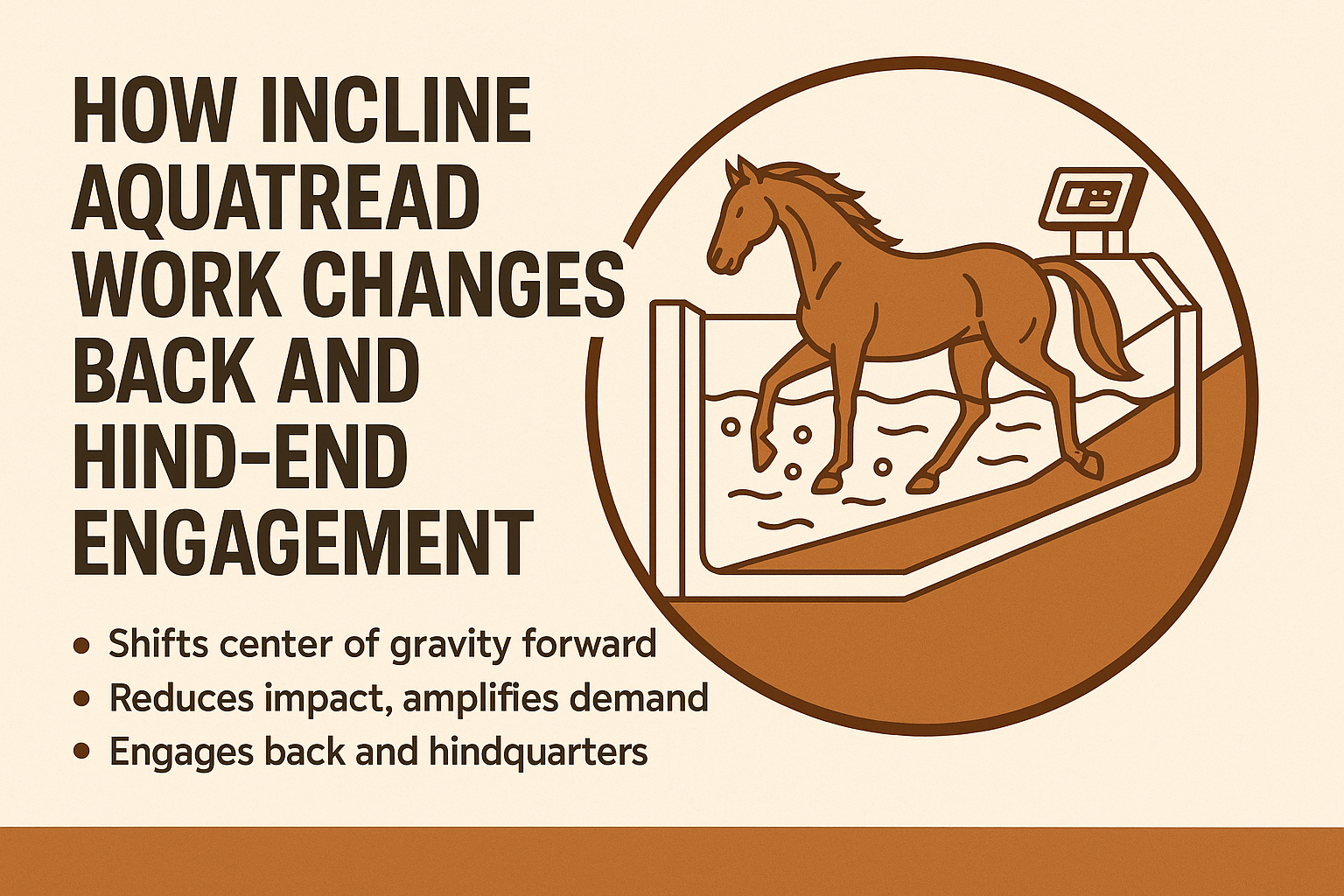
The Physics of Incline in Water
Incline AquaTread sessions tilt the underwater treadmill, typically 2-5 degrees. This simple adjustment shifts a horse's center of gravity forward. Suddenly, the hindquarters must generate more power to propel the body uphill—against water resistance.
Water buoyancy reduces impact by up to 90%, but the incline amplifies muscle demand without joint stress. Forward lean engages the back musculature differently than flat work.
Back Engagement: From Passive to Active
On a flat AquaTread, horses often travel with a relatively flat back. Introduce incline, and the topline activates. The longissimus dorsi and multifidus muscles contract to stabilize the spine against the forward pull.
This isn't subtle. Vets notice improved epaxial muscle tone after consistent sessions—firmer, more rounded backs that carry the rider better. Performance horses prone to hollowing develop a stronger "motor" here, reducing compensatory forehand reliance. Think of it as upgrading from economy to performance mode: the back now drives, not just supports.
Hind-End Propulsion: Power Where It Counts
Hind-end engagement skyrockets on incline. Gluteals, semitendinosus, and biceps femoris fire harder to push against the slope. Horses learn to step under themselves more effectively, mimicking collected gaits on land but with zero concussion.
Trainers report visible changes: deeper hock flexion, stronger stifle action, and that elusive "behind the bit" feel translating to dry work. For barrel horses or jumpers, this builds explosive hind power. Data from session videos shows stride lengths increase by 10-15% as propulsion efficiency improves—no guesswork, just biomechanics.
- Incline forces true engagement, not just faster steps.
- Horses fatigued in hindquarters first, revealing weaknesses early.
- Post-session, expect 24-48 hours of mild soreness—prime recovery window.
Practical Adjustments for Results
Start low: 2 degrees for 5 minutes, building tolerance. Monitor for signs of overload—shortened strides or tail swishing mean dial back. Pair with straight flat work to balance development.
Elite trainers integrate incline for rehabbing soft-tissue injuries or prepping for high-level shows. The controlled environment lets precise tweaks: shallower water emphasizes hind push; deeper adds back lift. Results compound over 4-6 weeks, with measurable gait symmetry via motion analysis.
One caveat: not every horse takes to it immediately. Patient progression unlocks the transformation. Your performance edge starts here, in the water.