What Happens Beneath the Surface?
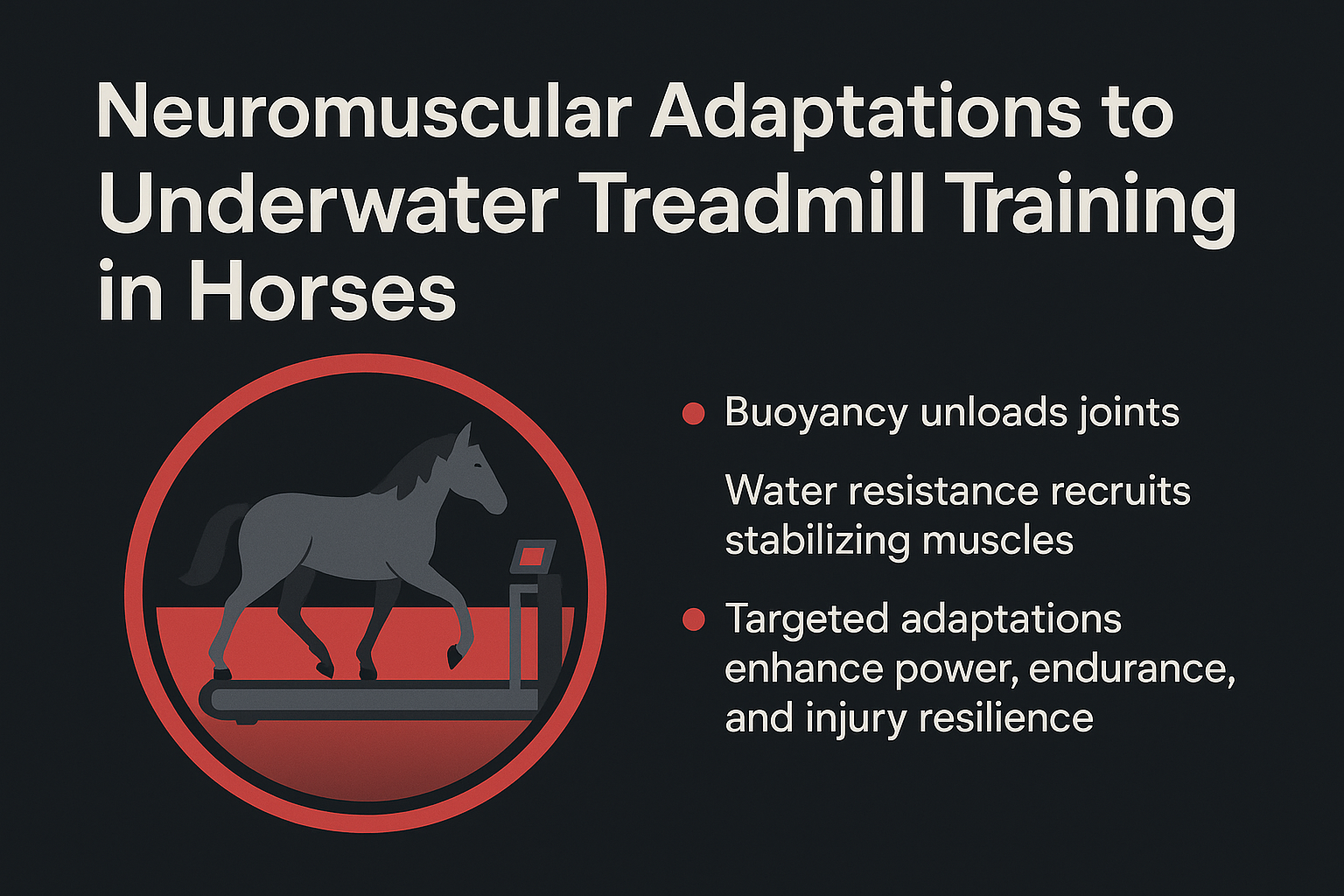
Underwater treadmill training challenges a horse's neuromuscular system in ways dry land can't match. Buoyancy unloads joints while water resistance recruits stabilizing muscles. The result? Targeted adaptations that enhance power, endurance, and injury resilience.
Picture this: a performance horse stepping onto the AquaTread. Each stride demands precise coordination between nerves and muscles, firing in harmony under altered physics.
Muscle Fiber Recruitment Shifts
Slow-twitch fibers dominate on land for steady trots. But submersion flips the script. Water's drag forces fast-twitch fibers to engage earlier, building explosive strength without pounding impact.
Research on equine athletes shows protocol-specific changes. After 4-6 weeks of sessions at 30-40% body weight support, biopsy samples reveal increased type II fiber cross-sectional area. Horses gain twitch speed and fatigue resistance—key for reining or jumping demands. Trainers notice quicker transitions; vets see balanced hypertrophy.
Neural Efficiency Takes Center Stage
Nerves learn efficiency fast in water. Reduced gravity heightens proprioceptive feedback, sharpening motor unit synchronization. Horses adapt by recruiting fewer motor units for the same effort, conserving energy.
This isn't guesswork. Electromyography studies confirm lower amplitude signals post-training, signaling refined neural drive. For elite competitors, that means sustained performance over multi-day shows.
- Proprioception boost: Enhanced joint position sense reduces stumble risks.
- Intermuscular coordination: Core and limb muscles sync better, stabilizing gait.
- Reflex modulation: Stretch reflexes calibrate to variable resistance.
Practical Timeline for Progress
Adaptations unfold predictably. Week one: neuromuscular activation ramps up, with horses showing tentative strides. By week three, stride length extends 10-15% under water, mirroring dry-land gains.
Longer protocols yield deeper changes. Eight weeks in, endurance horses exhibit 20% improved VO2 max proxies via lactate thresholds. World-class trainers integrate this data, timing sessions around competition peaks. Vets monitor via gait analysis, confirming symmetry improvements that prevent suspensory strains.
One caveat: overzealous protocols risk fatigue. Start conservative—three sessions weekly at waist-deep water—and progress based on stride metrics.
Why It Matters for Peak Performance
Neuromuscular tweaks from underwater work create resilient athletes. They rebound faster from setbacks, train harder without breakdown. For your high-end mount, it's the edge between good and unbeatable.
Track it yourself: pre- and post-protocol lameness exams, plus timed sprints. The data doesn't lie—adaptations deliver.